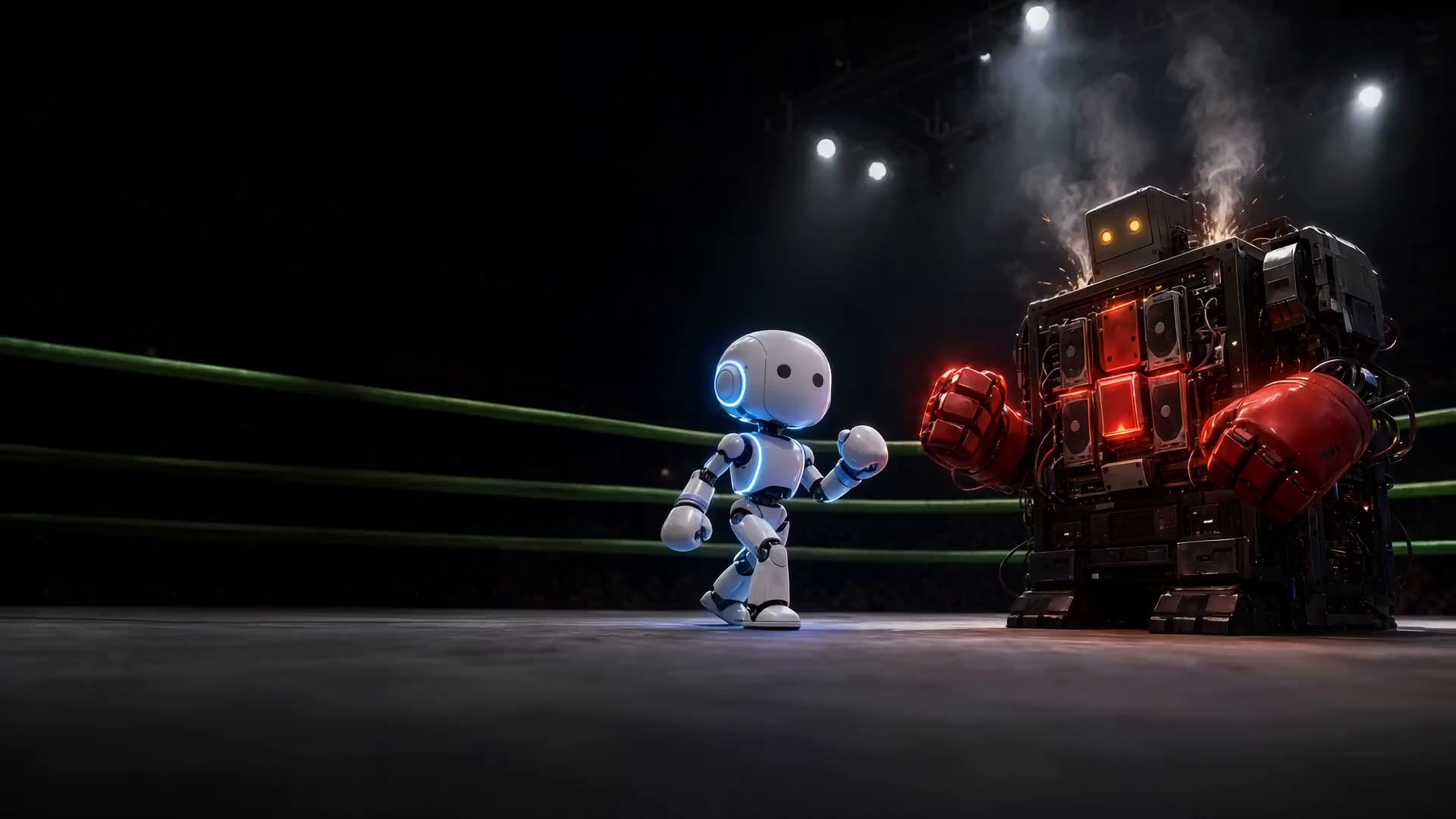
Main event: about 3 hours on a rented GPU box. About $55 at the real price ($28 on a spot discount). Zero mercy.
DeepSeek vs Opus: the numbers do not add up.
We rented 4 H200s to run DeepSeek V4.1 Flash in place of Opus 5.5 for our coding robots. It lost. Here is every number, round by round.
For anyone who has heard "DeepSeek is 80x cheaper, just switch" (or "just run it yourself") and wanted someone to actually check the math.
Cartoon, made with AI.
Tale of the tape
In this corner: DeepSeek V4.1 Flash
- 763B parameters
- 4x H200: $18.37 an hour at the real price ($9.19 on the spot discount we got)
- Sticker price: $0.60 per million written tokens
And in this corner: Opus 5.5
- Runs on our Claude Code subscriptions
- About $1 per merged code change in September
- 5,610 code changes merged in September
ZOMG GUY:
ZOMG IT'S OPEN SOURCE!! ZOMG IT'S 60 CENTS!! ZOMG 80x CHEAPER!!
We believed him too. So we rented the box. Here is what happened.

Round 1 -- The Hype
Free weights. Cheap tokens. What could go wrong?
Cartoon, made with AI.
ZOMG GUY:
IT'S OPEN SOURCE!! JUST RUN IT YOURSELF!!
The dream: run DeepSeek V4.1 Flash on our own rented GPUs. Point Claude Code at it. Run 64 to 128 robot coders at once. Save a fortune.
The model is huge: 763B parameters, including a 197B memory module, with a 1M-token context.
8x H200 boxes were sold out all morning, so we grabbed a 4x H200 box. Its real price (the kind they cannot take back) is $18.37 an hour. We paid the spare-capacity (spot) price, $9.19 an hour: about half, because the provider can take the box back.
Open source means the weights are free. Free like a free puppy.
The puppy comes with a ~511 GB download, a box to keep it in at $18.37 an hour ($9.19 on a spot discount), 5 starts before it stayed up, and somebody on call who speaks fluent GPU.
Round 1: DeepSeek, on the sticker. $0.60 per million written tokens is a tiny number.
Does not add up, part 1: the weights are free. The box to hold them is $18.37 an hour ($9.19 on spot).
Round 2 -- The Expertise Tax
It took 5 starts to get it stable.
Made with AI.
Every start meant loading the model back in: about 10 to 15 minutes, every single time.
- Start 1: out of GPU memory. A speed trick called "adaptive verification" ate 41 GB per card.
- Start 2: froze while recording its GPU shortcuts. We sent deep-research robots. They traced it to that same adaptive-verification setting.
The owner, mid-freeze: "dont restart anything let it go"
- Start 3: crashed on a memory setting that stops the cards from talking to each other.
- Start 4: it worked! Then we threw 256 robots with long answers at it. Crash. We found the box's limit.
- Start 5: 128 robots max, 90% memory. Stable. Finally.
Bonus pain: a progress bar that said "48/48 files" and meant nothing. And our own script matched itself and killed the wrong thing.
ZOMG GUY:
JUST SPIN IT UP, BRO!!
We did. Five times.
Self-hosting is not a download. It is a job. You need a GPU whisperer on call.
Round 2: Opus 5.5. It comes with our Claude Code subscriptions: no box to rent, no 511 GB download, no restarts.
Does not add up, part 2: 5 starts, 10 to 15 minutes a start, before it stayed up under load.
Round 3 -- The Flex
Fair is fair: the box was fast. On paper.
Cartoon, made with AI.
Once it ran, we hit it with one-minute full-load tests, one kind of work at a time. Zero errors.
Reading brand-new text:16,621 tokens a second (1.44 billion a day).
Re-reading saved text (cache):521,027 tokens a second (45 billion a day).
Writing:5,281 tokens a second (456 million a day). In the long-answer test it hit 5,871 a second.
All 4 GPUs at 100%, about 600 W each.
ZOMG GUY:
HALF A MILLION TOKENS A SECOND!! UNSTOPPABLE!!
Those numbers are real, and each one was measured alone. Real coding work does not come one kind at a time.
Round 3: DeepSeek. Raw muscle.
Does not add up, part 3: 5,281 written tokens a second sounds huge. Now watch what real work does to it.
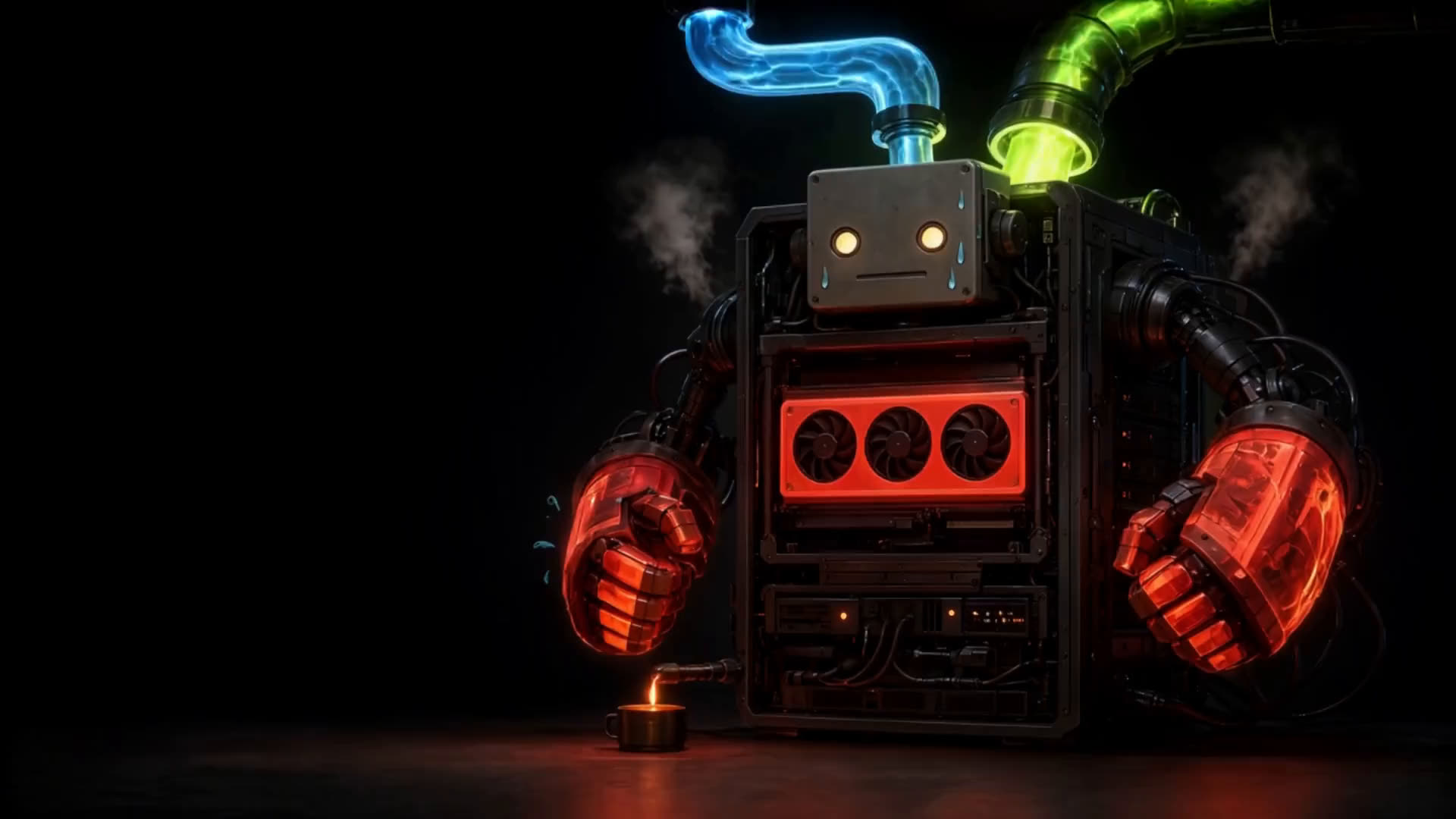
Round 4 -- The Real Mix
Why 4 H200s top out around 200 written tokens a second
Cartoon, made with AI.
- New input (blue): text the model has never seen.
- Cache (green): re-reading the conversation it already saw.
- Output (orange): what it writes.
Coding robots re-read the old conversation over and over. In our real Claude Code September, 96% of all input was re-reading old conversation.
For every 1 token Claude writes, it reads 41.6 new tokens and 1,042 old ones.
One average call re-reads about 196,000 tokens. A small novel, every call.
Every token costs box time.New: 60 microseconds.Re-read: 1.9 microseconds.Written: 189 microseconds.
Run our real mix through that, and 4x H200 top out at about 213 written tokens a second. About 20 billion tokens a day, in total.
We checked the formula against the live test. It matched within 3%.
Our busiest day in September was 51 billion tokens. The box tops out at about 20 billion a day.
ZOMG GUY:
BUT 521,027 A SECOND!!
Each re-read is cheap, buddy. But we do 1,042 of them, plus 41.6 brand-new tokens at 60 microseconds each, for every 1 token written. That is about 4,700 microseconds of box time per written token: about 213 a second, for the whole box.
Four H200s, pinned at 100% and about 600 W each, top out around 213 written tokens a second on real coding work. For everyone on the box, combined.
Opus 5.5 wrote about 85 tokens a second for EACH call.
Round 4: Opus 5.5.
Does not add up, part 4: 4 H200s, about 213 written tokens a second, shared by everyone.
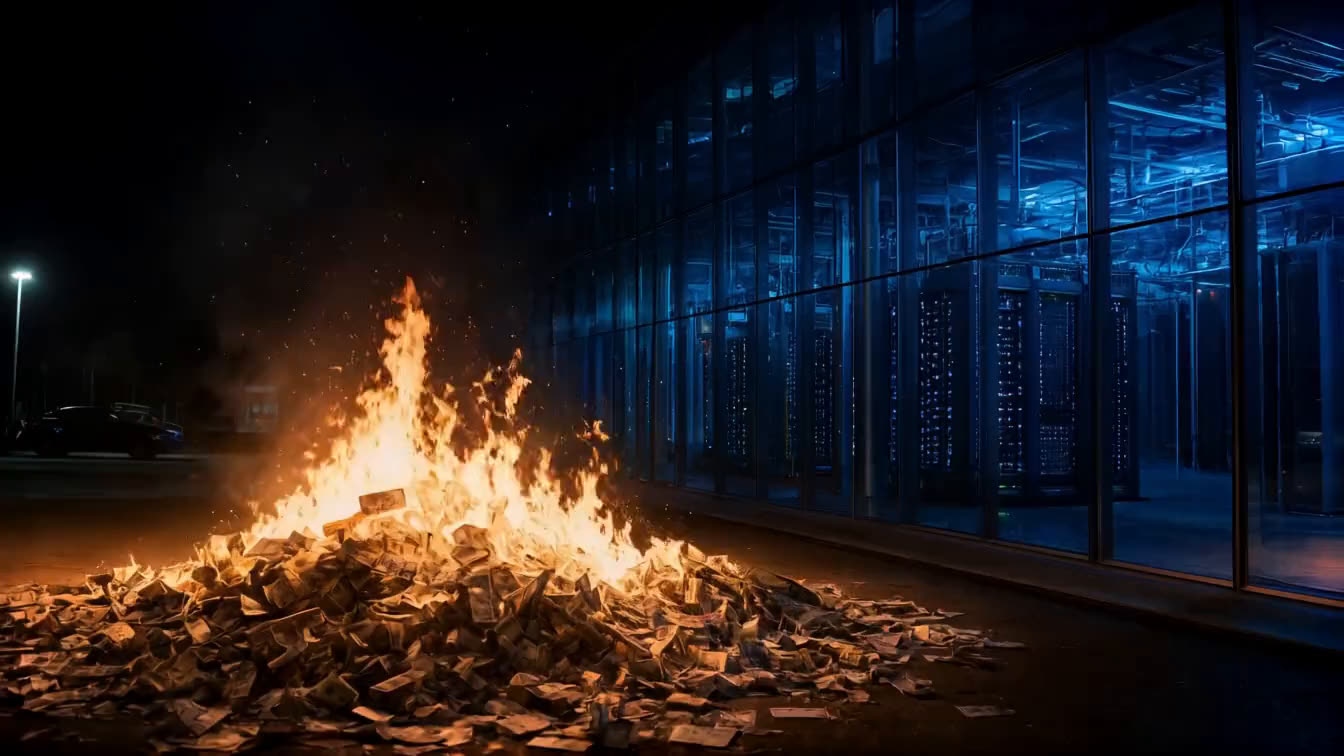
Round 5 -- The Box vs the Cloud
DeepSeek vs DeepSeek: at the real price, the box loses to its own cloud.
Made with AI.
DeepSeek also sells the same model by the token, on its own cloud.
The box costs $441 a day at the real price ($18.37 x 24 = $440.88), busy or not. On the spot discount we got: $220 a day.
A full, 100%-busy day of box work is worth $184 to $223 at DeepSeek's own per-token prices.
At the spot price, running flat out all day, the box only ties DeepSeek's own cloud. At the real price it costs 2x to 2.4x as much ($440.88 / $223 = 1.98; $440.88 / $184 = 2.40).
The spot discount is the only reason the box even tied. And you cannot run a business on a box that can be taken back. Ours was, minutes after the last test.
And that is before the restarts, the waiting and the expert on call.
DeepSeek's cloud prices per 1 million tokens, off-peak, are $0.15 new, $0.003 cached and $0.60 written. They double at weekday peak.
ZOMG GUY:
BUT YOU OWN IT!!
We rented it, on a discount that can be taken back. At the real $18.37 an hour, the cloud does the same work for about half the money or less, and nobody has to babysit it.
Round 5: DeepSeek's own cloud. The box only ties it on a spot discount.
Does not add up, part 5: $441 a day at the real price, for $184 to $223 of work. Even on the $220 spot discount, at most a tie.

Round 6 -- The Gaslight
Sure, DeepSeek's cloud is cheaper. Per token. On paper.
Cartoon, made with AI.
ZOMG GUY:
80x CHEAPER THAN CLAUDE!!
That 80x compares DeepSeek's price per token to Claude's posted list price. Nobody on a Claude Code plan pays list price.
Claude Code plans are 27 to 35 times cheaper than Claude's posted pay-per-token price. That is the owner's figure.
Divide the 80x by that, and most of the gap is gone.
Our real September (Sep 1-27, one server): our Claude Code subscriptions cost about $5.5K. The same usage on DeepSeek's cloud: $3.5K off-peak, $7.0K at peak.
So DeepSeek's cheap cloud lands somewhere between a bit cheaper and more expensive. Calling that "80x cheaper" is not a saving. It is gaslighting.
Now count what actually ships. Our Claude subscriptions came to about $1 per merged code change in September: 5,610 changes merged, 5 reverted.
Even on DeepSeek's cheap cloud, our estimate is $1.15 to $4.90 per merged change, after all the extra checking it needs.
Getting it right the first time is the cheapest token there is.
Round 6: Opus 5.5, per shipped change.
Does not add up, part 6: "80x cheaper" per token turned into about the same or worse per change that actually ships.

Round 7 -- Speed and Brains
It is slow, too.
Cartoon, made with AI.
ZOMG GUY:
IT'S 60 CENTS!!
It is $0.60 per MILLION written tokens. And who cares, when the first reply takes 12.8 seconds (56.6 on a bad one) and it writes 8 tokens a second on the shared box?
| Opus 5.5 | DeepSeek robots | |
|---|---|---|
| First reply, typical | 3.5 s | 12.8 s |
| First reply, slow | 9.6 s | 56.6 s |
| Writing speed per call | about 85 tokens/s | about 8 tokens/s (shared box) |
| Conversation being read | 542,000 tokens (median) | 24,000 tokens |
| Calls measured | 26,680 | 853 |
Opus answered faster while reading conversations 20x longer.
Brains: on public test scores for hard terminal coding, DeepSeek Flash gets about 31. Opus 5.5 gets about 66.
One of those is a passing grade.
Round 7: Opus 5.5. Faster and sharper.
Does not add up, part 7: 8 tokens a second per call. A cheap token you sit and wait for is not cheap.

Round 8 -- The Knockout
DeepSeek shipped zero lines of code.
Cartoon, made with AI.
The plot twist: the reviewers of our robot sandbox kept finding ways robot code could escape.
One example: a settings file dropped in a shared temp folder could make robot code run as the admin.
So the builder robots never got switched on.
Fair is fair: during the run, 48 to 64 read-only reviewer robots read 2,377 folders of our code and filed 32 bug reports.
Code shipped by DeepSeek: zero lines. Code changes merged on our Claude subscriptions in September: 5,610.
After about 3 hours (about $28 on the spot discount, about $55 at the real price), the spare-capacity box was taken back by the provider, minutes after the last test.
Even the GPUs left us.
The official verdict, from the owner: "it sucked ass"
We went back to Opus 5.5 on high.
Want the subscription side priced out? The AI Career Lab ran the numbers: Can a $10 AI stack beat a $200 plan?
ZOMG GUY:
...
(ZOMG Guy has left the chat.)
Round 8: Opus 5.5, by knockout.
Does not add up, part 8: 763B parameters. Zero lines shipped.
The scorecard
- Round 1, The Hype: DeepSeek (on the sticker)
- Round 2, The Expertise Tax: Opus 5.5
- Round 3, The Flex: DeepSeek (raw muscle)
- Round 4, The Real Mix: Opus 5.5
- Round 5, The Box vs the Cloud: DeepSeek's own cloud (the box only ties on a spot discount)
- Round 6, The Gaslight: Opus 5.5
- Round 7, Speed and Brains: Opus 5.5
- Round 8, The Knockout: Opus 5.5
Result: Opus 5.5 wins. It was not close.
The Insane Fact Sheet
Every number from the fight, measured, each on its own giant card.
The Beast (the model)
The Box (the thing we rented)
The Install Saga (5 starts)
The Flex (one-minute full-load tests)
The Formula (box time per token)
The Real Price (no spot discount)
The Money
The Speed Race (real logs)
Brains
Our Real September (Sep 1-27, one server)
The Ending
Do the math yourself
- 1. The sticker: "80x cheaper" than Claude's posted list price, per token.
- 2. The plan discount: Claude Code plans are 27 to 35 times cheaper than that posted price (the owner's figure). Most of the 80x is gone.
- 3. A real month: our Sep 1-27 usage would cost $3.5K (off-peak) to $7.0K (peak) on DeepSeek's cloud. Our Claude Code subscriptions cost about $5.5K.
- 4. Run it yourself: 96% of input is re-reading. Per 1 written token the box reads 41.6 new and 1,042 old. Box time: 41.6 x 60.2 = 2,503 microseconds (new) + 1,042 x 1.92 = 2,000 (re-reads) + 189 (the written token) = 4,692 microseconds. 1,000,000 / 4,692 = about 213 written tokens a second, for the whole 4x H200 box. (60.2 and 1.92 are the 60 and 1.9 before rounding.)
- 5. Price the box: $18.37 an hour x 24 = $440.88 a day at the real price ($220 a day on the spot discount). A full, 100%-busy day of its work is worth $184 to $223 at DeepSeek's per-token prices. At spot, a tie. At the real price, 2x to 2.4x the cloud ($440.88 / $223 = 1.98; $440.88 / $184 = 2.40).
- 6. Price what ships: about $1 per merged change on our Claude subscriptions. $1.15 to $4.90 estimated for DeepSeek, after the extra checking.
- 7. Count what shipped: 5,610 merged changes on our Claude subscriptions in September. DeepSeek: zero lines.
None of it adds up.
Before you switch models, ask one question:
What does ONE shipped change cost?
Price per token is a lie. Price per shipped change is the truth.
Republish this freely -- full or excerpt -- with credit and a link back to this page.