

The Roofing Accelerator by The Call Center Doctors
A complete financial overhaul. You will know where every penny is.
Bookkeeping for roofers, done as a complete overhaul: audit-ready, exit-ready books closed by the 5th of the month for the month prior, real-time AI analytics on every penny, and your cash collected for you. Profit you can see, not profit you hope for.
jason@ccdocs.comSarah, who answers our phone line, is our AI assistant.
Made with AI
You know every roof. Do you know every penny?
You can walk a roof and tell the homeowner what failed, what the fix takes and how long the crew needs. You know which crew is fastest, which supplier runs late and which adjuster will fight the supplement.
Now answer a harder question just as fast: what did you actually make on the roofs you finished last month? Not what you sold. What you kept.
Many owners cannot answer that, and it is not because they are careless. The books come last because everything else comes first: the phone at night, the storm that just rolled through, the crew that did not show up.
So bookkeeping for roofers too often means books that exist for the tax return, and a bank balance you check every morning to guess how the month is going. That is not a way to run the money. It is a way to find out, too late, where it went.
We will squeeze every last penny out of every last thing in your business. It starts with books you can trust, closed fast and read every day.
Where roofing profit leaks when the books run late
Slow books do not look like a problem. They look like a normal month, and that is exactly why the leaks run for years.
Jobs that lose money in silence
Without job costing, a roof that lost money looks the same as a roof that made money: both are just deposits. You keep bidding the losing kind, because nothing in your books tells you to stop.
Cash stuck in other people's bank accounts
82% of contractors now wait more than 30 days to get paid, up from 49% two years earlier.1 In roofing, that is the final payment nobody chased, the depreciation check still with the carrier and the supplement that was approved and never billed.
Fees to reach your own money
59% of small businesses paid extra fees last year just to access money they had already earned.2 Every one of those fees is margin you earned on the roof and gave away in the office.
A thin cushion in a seasonal trade
The median small business holds only 27 days of cash; a quarter hold fewer than 13 days.3 Roofing runs on seasons and storms. A thin cushion turns a slow month or a late insurance check into a payroll problem.
The owner gets paid last
47.7% of small business owners have skipped or delayed their own paycheck to keep the business running.4 That is what running a company by the bank balance looks like: busy all year, and still the last one paid.
Books a buyer will not trust
Buyers value a company on EBITDA (your yearly profit before interest, taxes and a few accounting items). Professionally prepared EBITDA often shows 15-30% more profit than tax-focused statements.5 Profit you cannot show is profit a buyer will not pay for.
Bookkeeping for roofers that closes by the 5th
A close date on the calendar, every month, whether it is storm season or not.
Audit-ready, exit-ready books. We close your books by the 5th of the month for the month prior.
By the 5th, last month is finished: every deposit matched, every bill entered, every cost sitting on the job it belongs to, and a real profit number in front of you while this month is still young enough to change.
The median company needs 6.4 days to close its monthly books; the best 25% do it in 4.8 days or less; the bottom 25% take 10+ days.6 Closing by the 5th puts your books ahead of the typical company in that study and close to the pace of its fastest quarter.
What lands in front of you by the 5th is short and plain: last month's profit and loss, the balance sheet, a profit line for every job, and a list of every dollar still owed to you, oldest first.
Then the balance sheet: what you owe, what you are owed and what is in the bank, checked against each other every month. When they agree month after month, a stranger can check your books and find every number where it should be. That is what audit-ready means.
The close is run by our team, not by whoever in your office has a free afternoon. The people behind it are part of the nearshore back office, recruiting and training we run with you. On the strategy call, ask who keeps your books and how the close is run.
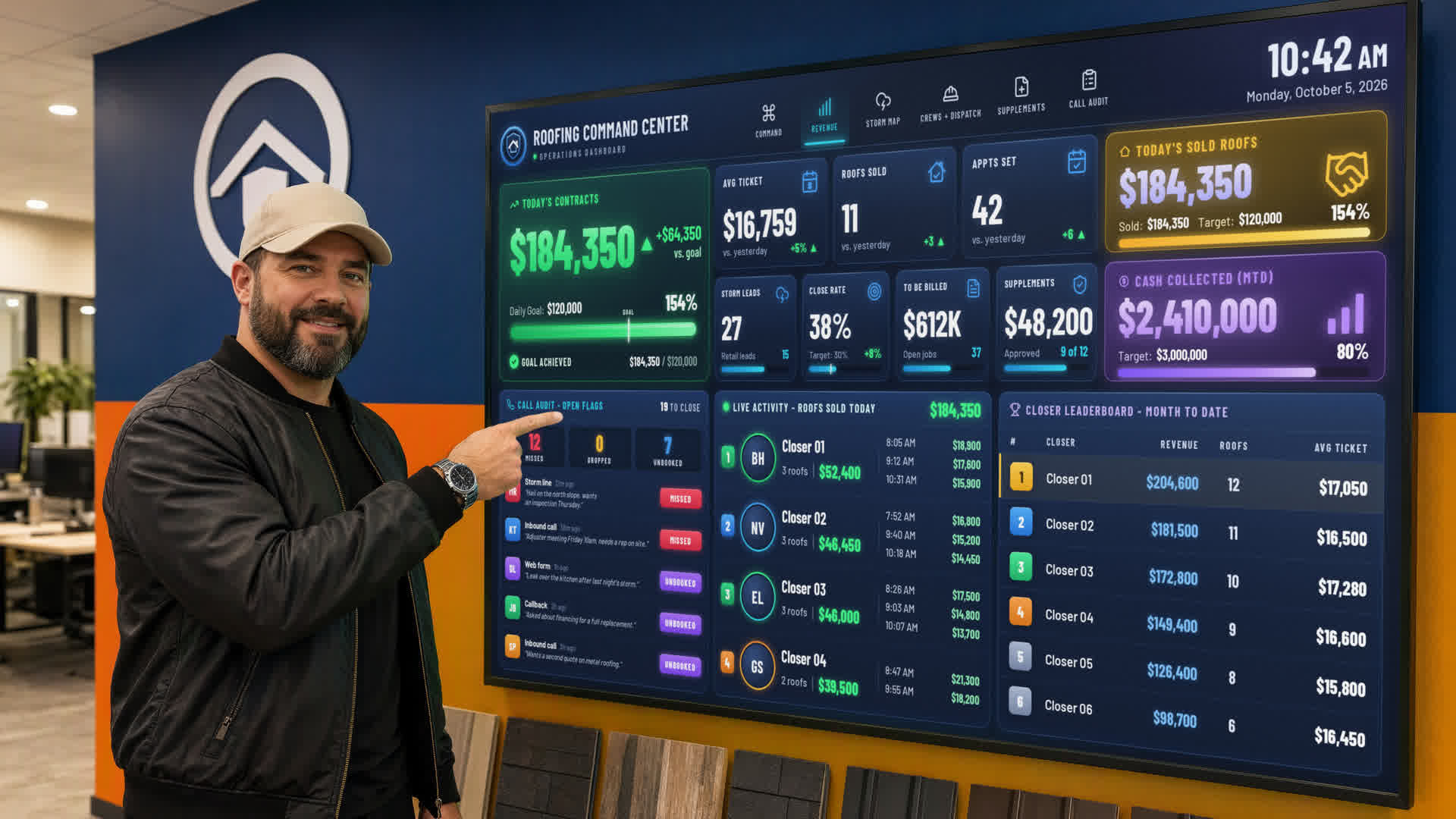
Real-time AI analytics: every penny, every day
The monthly close tells you what happened. The live view tells you what is happening.
Illustration: your numbers, live on the wall. Made with AI.
Real-time AI analytics, so you know where every penny is at all times. We install a real-time roofing dashboard in your office, so you can watch your numbers live.
Not a report you wait for. A live view of your company: jobs sold and installed, cash collected and still owed, what each lead source costs you per signed job, what each crew produced, and where overhead is creeping up.
Open it before the first crew leaves the yard and you already know what came in yesterday, what goes on a roof today and which unpaid invoice needs a call before noon.
The AI does the first read for you. It watches the numbers every day and points at what moved: a job running over its material budget, an invoice sliding past due, a lead source that got more expensive this week. You get the question to ask before the problem gets expensive.
Most of your competitors are not doing this. Nearly 79% of roofing contractors use no AI at all; only 4% use AI built into their CRM.7 While they wait for a month-end report, you are reading this morning's numbers.
You cannot cut a cost you cannot see, and you cannot stop a leak nobody has found. Every penny in plain sight is where the squeeze starts.
The same system reads your calls, your follow-up and your orders, because the numbers are only one part of AI in every workflow of your business.

We collect your cash
Revenue is a promise. Cash is the roof actually paid for.
Made with AI
We collect your cash for you.
59% of small businesses have invoices overdue by 30+ days, up from 47% a year earlier; they are owed $17.7K on average.2 That is money for work already done, sitting in someone else's account.
In roofing, the money hides in familiar places. The final payment after the install. The depreciation check the carrier releases only when someone sends the right paperwork. The supplement that was approved and never billed. The commercial invoice waiting on a lien waiver (the signed release a property manager asks for). Every one of them is a roof you already paid for, in materials and labor.
Nobody in your office wants to make those calls, so they get made late or not at all. We make them: polite, on a schedule and in the tone you set, with a record of every promise to pay. Every dollar is entered in your books the day it arrives.
When the money owed to you comes in on a schedule, payroll stops depending on who happened to pay yesterday.
We run your collections through a call center that answers every call and follows up every lead, so getting paid never depends on you finding a spare minute at the end of a long day.
Cash collected is margin kept. Money that sits unpaid costs you twice: once in the fees and borrowing that cover the gap, and again in the jobs you could not start because the cash was not there.
Roofing profit margin: the levers, line by line
Revenue is what you sell. Profit is what you keep. We work every line in between.
We will squeeze every last penny out of every last thing in your business.
Costs climb whether anyone is watching them or not. Rising labor and overhead costs are the top threat to growth for 39% of roofing contractors; skilled labor shortage for 34%.7 Over half of roofing contractors report rising labor costs, up 14% on average.8 A margin nobody manages shrinks on its own.
The profit math, line by line, in words. Every line is a number your books should hand you without a phone call.
Your own numbers, margin included, go into the calculator further down this page.
| Line | What it is | The formula | Why it matters |
|---|---|---|---|
| 1 | Sign each job at a known cost | marketing spend / signed jobs = cost per acquisition | Unlimited sales at a fixed cost per acquisition. What it costs to sign each job is the first margin lever, and every job's cost shows up on your books. See roofing appointments at a fixed cost per acquisition. |
| 2 | Cost every roof | materials + labor + subcontractors + permits + disposal + commissions = job cost | Job costing on every roof. Miss even one of these lines and a losing job looks like a winner. |
| 3 | Find the gross profit on each roof | what the homeowner pays - job cost = gross profit on that roof | Split by storm and retail, residential and commercial, this line shows you which work to chase and which work to stop bidding. |
| 4 | Cut the overhead | office payroll + rent + software + trucks + insurance + everything else = overhead | Cut back-office costs up to 30% with our nearshore team in Monterrey and Guadalajara. Nearshore means our team next door in Mexico. Every dollar that comes out of overhead drops straight to profit. |
| 5 | Keep what is left | gross profit on every roof - overhead = operating profit (profit before interest and taxes) | This is the number that pays you, funds the next storm season and, one day, sets the value of the company. |
| 6 | Turn billed work into cash | what you billed - what is still owed to you = cash collected | Profit on paper does not make payroll. We collect your cash for you, so the profit in your books is also in your bank. |
| 7 | Watch every line, every day | every line above, updated daily = where every penny is | Real-time AI analytics, so you know where every penny is at all times. A lever you can see is a lever you can pull this week, not next quarter. |
| 8 | Multiply it on the day you sell | adjusted EBITDA (operating profit before depreciation, with one-time and owner-only costs added back) x the multiple = what your company is worth | Clean profit counts twice: once every year in your bank account, and again, multiplied, on the day you sell. The multiple is explained in how a roofing company gets ready to sell. |

Audit-ready and exit-ready: what buyers look for in your books
A buyer's accountant reads your books before anyone looks at your roofs.
Made with AI
Put yourself on the other side of the table. A buyer's first request is your financial statements, usually for several years, and the first question is whether the profit in them is real.
Audit-ready means a stranger can check every number. Exit-ready goes one step further: the books show your real earning power the way a buyer measures it, with every job costed, revenue split by type of work, and one-time and owner-only costs kept apart from the cost of running the company.
Roofing companies with documented systems, real financial reporting and the owner in a strategic role are valued at 7X+ EBITDA by M&A advisors.5 Real financial reporting is in that sentence for a reason: it is the proof behind every other claim you make about your company.
Books that only you can explain are a risk a buyer prices in. Transition risk alone can create valuation gaps of 40-75% between similar roofing companies.5
And going to market is not the same as selling. Only 20-30% of businesses that go to market actually sell.9 Clean books, closed every month, are one of the things that separate the companies that sell from the ones that come back off the market.
We help you exit in 3 years or less, and we set up everything to exit, end to end. The books are where that starts. The full plan is on getting your roofing company ready to sell.
Job costing on every roof
A roof that lost money looks exactly like a roof that made money, until you cost it.
Job costing on every roof is part of every close. Each job carries its own materials, labor, subcontractors, permits, disposal and commissions, so every roof shows what it cost and what it made. Storm jobs carry the insurance side as well: the approved scope, the supplements and the depreciation still owed.
Storm and retail, residential and commercial each land on their own lines. You see which kind of work pays you the most for the hours it takes, and which kind only keeps the crews busy.
This is the part of roofing accounting that changes what you bid next week. It is also what a buyer checks: every job costed is the proof that the profit in your books is real.
A bookkeeping service vs a complete financial overhaul
Most roofing companies already pay someone to do the books. The question is what they get for it.
A bookkeeping service records what happened. A financial overhaul changes what happens next. The difference, line by line:
| What changes | The usual way | With The Roofing Accelerator |
|---|---|---|
| When last month is closed | Whenever the bookkeeper gets to it, often weeks later | By the 5th of the month for the month prior |
| What the books are for | Filing taxes | Running the company today and selling it one day: audit-ready, exit-ready |
| Job costing | Done only if you ask, and rarely split by type of work | Every roof costed: storm and retail, residential and commercial |
| Seeing the numbers | A report once a month, if you ask for it | Real-time AI analytics, so you know where every penny is at all times |
| Late invoices | Listed on a report for you to chase | Collected for you, on a schedule, with a record of every promise to pay |
| Your margin | Not their job | Every margin lever worked, line by line, every week |
| How you hear about it | When you remember to look | A weekly CEO report, and the big calls are yours |
| What a buyer finds | Tax returns and a list of questions only you can answer | Monthly books, closed on time, ready for a stranger to check |
Growth we put our name to. Profit we build together.
Much of this page is about keeping more of what you sell. The other half of the job is selling more, and that half comes with our name on it.
Industry-wide, one-third of roofing contractors report EBITDA margins between 6% and 15%.7 That is the industry's number, not ours and not a promise. Add millions in new jobs to a thin margin and you get a bigger, busier version of the same problem.
Not a thin $5M-$10M. A wildly profitable $5M-$10M.
The guarantee covers new business. Profit comes from the work we do together on every margin lever, and we show you that math line by line.
Who runs the numbers with you
Our founder's two facts below are why roofing numbers are familiar ground for us: what a lead costs, what an appointment turns into, and what a signed job leaves behind.
The financial overhaul is one of the ten parts of The Roofing Accelerator. The partner that runs your appointments, your calls and your collections also keeps your books, so the cost of every lead and the cash from every roof land in one set of numbers.
We've worked with over 1,500 roofing companies.
Jason Shouldice, founder We spend $150,000 a day on Google roofing leads and book hundreds of roofing appointments every day.
Jason Shouldice, founder
Every big money decision stays yours
Handing us the books is not handing us the checkbook. You keep final say. We run day-to-day. Every week you get a CEO report, and you approve the big calls.
The big calls on money are yours: which jobs to bid, what to spend on growth, which vendors to keep, when to borrow and when to pay debt down. Your bank accounts stay yours, and who can open each one, for which job, is one of those calls. We bring the numbers and a recommendation. You decide.
If you already have a bookkeeper or a controller, that role goes through the same audit as every other role in the company. Work that needs a person either moves to our team or stays with your people and gets easier, and nothing moves before you have seen why.
We become your CEO with you. See how Sarah takes calls, texts and emails off your plate.
You will see more of your company than you do today, not less: the dashboard in your office every day, the weekly CEO report and a closed month by the 5th. Your part is the part only you can do: reading it and making the big calls.
We are doing this together.
Your profit and your exit value, in your own numbers
Type in your leads a month, your close rate, your average job and your own margin. You will see an estimate of your yearly revenue and profit at those numbers, and what the company could be worth at a founder-run multiple and at a systemized one.
The multiples come from one published source. Roofing M&A advisors put owner-dependent roofing companies at 3-4X EBITDA, companies with a management team at 5-6X, and systemized companies with the owner in a strategic role at 7X+.5 Every other number is yours, and your books are where the real ones come from.
Why your books cannot wait for tax season
Life is short. None of us is promised tomorrow. Why wait a day?
Every month the books close late is a month of decisions made blind: bids priced on guesses, invoices left to age, overhead creeping up with nobody watching it.
The first 90 days: the Winter Sprint. Weeks 7-13: the full appointment flow, and books closed by the 5th. So your first close by the 5th lands inside the Winter Sprint, and the next storm season runs on clean numbers from its first day.
Books that are behind today are a reason to start, not a reason to wait. The audit rewrites every process in the company from the ground up, and your books are one of them.
And whenever you choose to sell, a buyer will ask for years of history. Every month you close cleanly from now on is a month of that history already written down.
Questions about the financial overhaul and your books
How much profit do roofers make per roof?
It depends on the job, and you only know it for your own company when your books cost each roof separately. Industry-wide, one-third of roofing contractors report EBITDA margins between 6% and 15%.7 That is the industry's number, not ours and not a promise. The real answer for your company comes from job costing: materials, labor, subcontractors, permits, disposal and commissions set against what the homeowner paid, on every roof, closed every month.
How fast should a roofing company close its books each month?
As fast as the numbers can be trusted. The median company needs 6.4 days to close its monthly books; the bottom 25% take 10+ days.6 Audit-ready, exit-ready books. We close your books by the 5th of the month for the month prior. That puts last month's real profit in front of you while this month is still young enough to change.
What type of accounting is used in construction?
For running the company, the accrual method shows the truth: revenue and costs land in the month the work happens, not the month the cash moves. Accounting for contractors adds one more layer on top: job costing, so every job shows its own profit. Long jobs, such as a large commercial roof, can be recorded as the work progresses. Your tax preparer picks the tax method; the books we keep make every job and every month clear.
How should a roofing company track job costs?
Give every roof its own job in the books and put every cost against it: materials, labor, subcontractors, permits, disposal, equipment and sales commissions. Storm jobs also track the insurance side: the approved scope, the supplements and the depreciation still owed. Overhead stays on its own lines. At the close, each job shows what it cost and what it made, and you can compare storm with retail and residential with commercial.
Is AI replacing bookkeepers?
It is replacing a lot of the typing. Current AI and other technologies could automate work that takes up 60-70% of employees' time today.10 In bookkeeping, that means matching, sorting and flagging. Judgment stays with people: whether a number makes sense, what a cost really was, and what to do about it. The overhaul uses both: real-time AI analytics, so you know where every penny is at all times, and people who close your books every month.
What happens to my bookkeeper and my outside accountant?
We audit and rewrite every process in the company from the ground up. We examine every role and automate it. Your bookkeeping is one of those processes, and you approve the big calls. Work that needs a person either moves to our team or stays with your people and gets easier. Your outside accountant gets clean monthly books, every job costed, closed on a set date.
What are exit-ready books?
Books a buyer can trust without you in the room: every month closed on time, every job costed, revenue split by type of work, and one-time and owner-only costs kept apart from the cost of running the company. Roofing companies with documented systems, real financial reporting and the owner in a strategic role are valued at 7X+ EBITDA by M&A advisors.5 Exit-ready books are the real financial reporting in that sentence.
How do you collect my cash without upsetting my customers?
We collect your cash for you. That means polite follow-up on a schedule, in the tone you set, with a record of every promise to pay, so no invoice is left to age and no call is made in frustration. The tone is agreed with you before the first call goes out. Any big call on an account, such as a payment plan or a dispute, is yours to approve.
Who owns my books and financial data if the agreement ends?
You do. When the agreement ends, you keep the software and all the data in it, including your analytics, plus the written playbook and every process we wrote down. Every closed month and every job cost stays with your company, ready for your next accountant or your buyer.
What exactly is the guarantee?
At least $5M in new business in the next 12 months. In writing. We aim for $10M. If we miss $5M, we keep working free until we hit it. The conditions, printed plainly: you follow the playbook; you have install capacity; you are ready for the volume; you sign a 12-month agreement. The full terms are in the written agreement.
Apply, then book your strategy call
If you want books closed by the 5th, cash collected for you and every penny in plain sight, the first step takes a few minutes.
Winter is around the corner. Prepare now. We are doing this together.
Questions before you apply? Write to [email protected].
- 45 minutes on Zoom, weekdays 10am-6pm ET.
- Or call Sarah, our AI assistant, at (844) 766-3535. She answers, qualifies you and books your strategy call, or sets up a call back with our team.
- jason@ccdocs.com
A short application, then you pick a time for your strategy call on the spot.
Step 1 of 3
Your application is in.
Pick a time for your Roofing Accelerator Strategy Call now. You can also call Sarah, our AI assistant, at (844) 766-3535, or write to jason@ccdocs.com.
Book your Roofing Accelerator Strategy Call45 minutes on Zoom, weekdays 10am-6pm ET.
Keep reading
Every part of The Roofing Accelerator has its own page.
- The whole plan, in one readThe Roofing Accelerator
- Exit plangetting your roofing company ready to sell
- Back office and peoplethe nearshore back office, recruiting and training
- AI in every workflowAI in every workflow of your business
- Your CEO, clonedSarah and the owner's calls, texts and emails
Sources
Every number on this page is either our own, stated by our founder, or linked to its source below.
- Rabbet, report on how slow payments cost the construction industry (2024) https://rabbet.com/blog/how-slow-payments-are-costing-the-construction-industry-billions
- Intuit QuickBooks, "2026 Small Business Late Payments Report" (2026) https://quickbooks.intuit.com/r/small-business-data/small-business-late-payments-report-2026/
- JPMorgan Chase Institute, "Cash is King: Flows, Balances, and Buffer Days -- Evidence from 600,000 Small Businesses" (2016) https://www.jpmorganchase.com/institute/all-topics/business-growth-and-entrepreneurship/report-cash-flows-balances-and-buffer-days
- Patriot Software (survey), "Half of Small Business Owners Skip Their Own Paycheck to Survive" (2026) https://www.patriotsoftware.com/blog/accounting/small-business-owner-burnout-survey/
- AXIA Advisors, "How Much Do Roofing Companies Sell For?" (2025) https://axiaadvisors.com/how-much-do-roofing-companies-sell-for/
- APQC benchmark, published in CFO.com (Metric of the Month), "Metric of the Month: Cycle Time for Monthly Close" (2018) https://www.cfo.com/news/metric-of-the-month-cycle-time-for-monthly-close/659297/
- Roofing Contractor (reporting ServiceTitan's 2026 Roofing & Exterior Market Report), "Roofing Contractors Bet on Tech for Growth in 2026" (2026) https://www.roofingcontractor.com/articles/101759-roofing-contractors-bet-on-tech-for-growth-in-2026
- Roofing Contractor, "2026 State of the Roofing Industry Report" (2026) https://www.roofingcontractor.com/articles/101643-2026-state-of-the-roofing-industry-report
- Exit Planning Institute, "State of Owner Readiness" (2026) https://exit-planning-institute.org/state-of-owner-readiness
- McKinsey & Company, "The economic potential of generative AI: The next productivity frontier" (2023) https://www.mckinsey.com/capabilities/tech-and-ai/our-insights/the-economic-potential-of-generative-ai-the-next-productivity-frontier